![companies that buy houses [market_city]](https://image-cdn.carrot.com/uploads/sites/80065/2025/02/Company-That-Buys-Houses-1920x800.jpg)

A fire in your home creates stress and a lot of uncertainty about what comes next. The damage might seem overwhelming.
Still, you do have clear options for moving forward with a sale. Whether the fire caused minor smoke damage or major structural problems, you can sell your property and recover financially.

You have three main ways to sell a fire damaged house: repair it first and sell at full market value, sell it as-is to investors or cash buyers, or demolish the structure and sell the land only.
Each option works best for different situations based on how much damage occurred, your financial position, and how quickly you need to sell. Repair costs typically range from $3,000 to $51,000 depending on the severity of damage.
The path you choose affects how much money you walk away with. It also determines how long the process takes.
This guide breaks down each selling option, explains the legal requirements you must follow, and shows you how to maximize your proceeds.
You’ll learn the step-by-step process from getting damage assessments to closing the sale.
Key Takeaways
- Get professional damage assessments and appraisals before deciding whether to repair, sell as-is, or sell as land
- You must disclose all fire damage and repairs to potential buyers regardless of which selling method you choose
- Working with experienced professionals who handle fire damaged properties protects you legally and helps maximize your sale price
Immediate Steps After Fire Damage
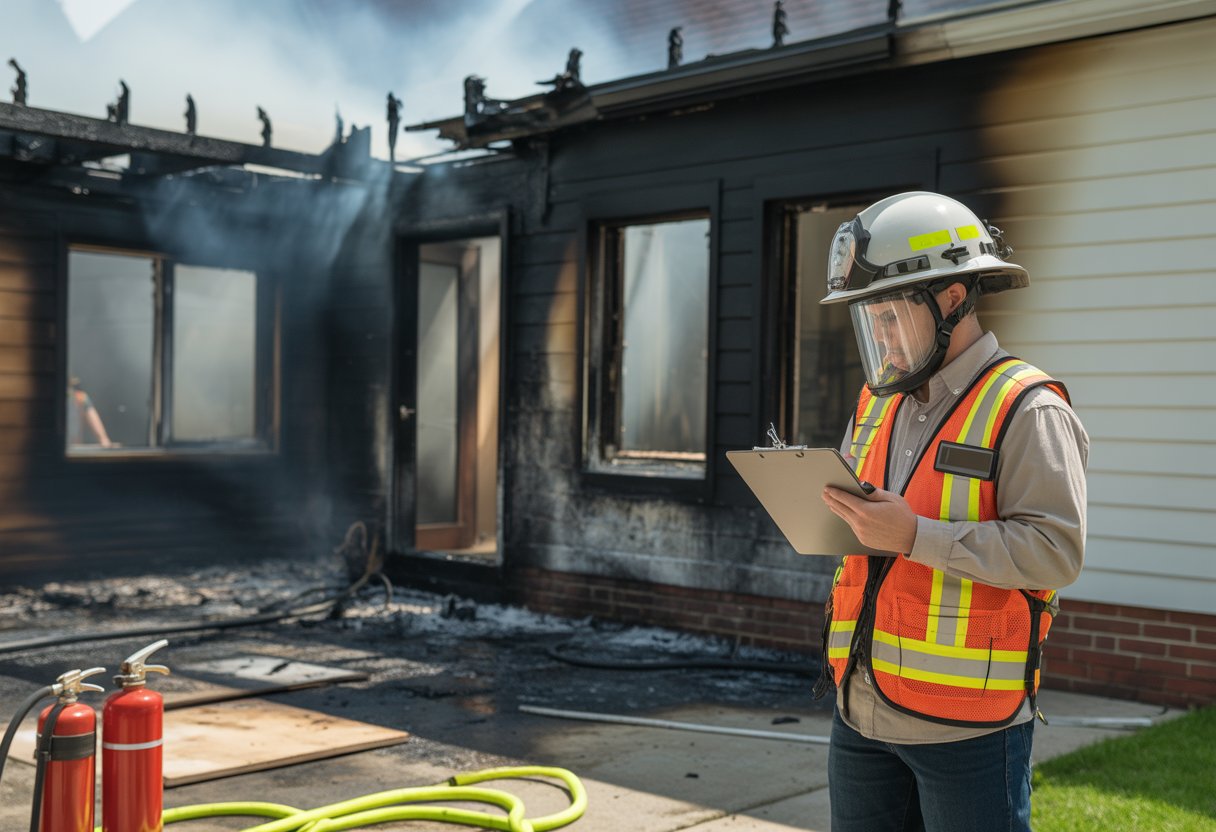
After a fire damages your home, taking the right actions in the first 24 to 48 hours protects both your safety and your financial interests. You need to secure the property.
Contact your insurance company immediately, and create detailed records of all damage.
Ensuring Safety and Initial Response
Do not enter your property until local authorities give you permission. Fire departments and building inspectors must confirm the structure is safe before you can return.
Once cleared to enter, watch for hidden dangers. Check for weakened floors, damaged electrical systems, and unstable walls or ceilings.
Smoke and soot can make surfaces slippery and dangerous. Turn off utilities if you can do so safely.
Water, gas, and electricity can create serious hazards in a fire-damaged home. Contact utility companies if you’re unsure how to shut off these systems properly.
Secure the property against weather and trespassing. Board up broken windows and damaged doors.
Cover holes in the roof with tarps to prevent water damage. Taking these steps after a house fire prevents additional damage that could reduce your home’s value or complicate your insurance claim.
Notifying Insurance and Filing Claims
Contact your insurance company within 24 hours of the fire. Many policies require prompt notification, and delays can complicate your claim or reduce your payout.
Ask your insurer these specific questions:
- What does your policy cover for repairs and rebuilding
- Will you receive cash upfront or reimbursement after repairs
- Does your coverage include temporary housing costs
- How does depreciation affect your payout
Request a copy of your full policy if you don’t have one. Review the coverage limits, deductibles, and any exclusions that might apply to fire damage.
Your insurance company will send an adjuster to inspect the damage. Schedule this inspection as soon as possible to start the claims process.
Keep all communication with your insurer in writing through email or certified mail.
Documenting Damage for Claims and Sale
Take photos and videos of every damaged area before touching or moving anything. Capture wide shots of each room and close-ups of specific damage to walls, floors, ceilings, and belongings.
Make a detailed list of damaged items with descriptions, ages, and estimated values. Include receipts or purchase records when possible.
This inventory supports your insurance claim and helps you price the property correctly when selling. Get a professional damage assessment from a qualified home inspector or fire restoration specialist.
This assessment differs from the basic inspection your fire department conducted. A professional evaluation reveals hidden damage to electrical systems, HVAC, and structural elements that smoke penetrates beyond visible surfaces.
Save all documentation including inspection reports, contractor estimates, insurance correspondence, and repair receipts. You’ll need these records when selling a house with fire damage because buyers and their lenders require proof of the damage extent and any repairs completed.
Understanding Your Selling Options

After fire damage, you have three main paths forward. Each option affects your timeline, profit, and effort differently based on the damage level and your financial situation.
Repair and Sell on the Traditional Market
Making repairs before you sell gets you the highest price for your home. This approach attracts the widest pool of buyers and lets you market the property like any other home.
You need enough money to cover repair costs, which typically range from $3,000 to $51,000 in 2025. The process requires several months to complete all work and obtain proper permits.
Every repair must be permitted and documented for future buyers. This option works best when:
- Fire damage was minimal or mostly cosmetic
- You have funds available for repairs
- You want to maximize your sale price
- You can wait 3-9 months to complete the sale
Keep in mind that even after repairs, some buyers may hesitate due to the fire history. You must disclose all fire damage and repairs regardless of how thorough your restoration work was.
Sell As-Is to Cash Buyers or Investors
Selling your fire damaged property as-is means no repair costs and a faster timeline. Cash buyers and real estate investors actively look for these properties.
You can typically close in 30-90 days with this option. The trade-off is accepting 20-40% below market value.
Your insurance payout helps offset the reduced sale price.
As-Is Sale Benefits:
| Advantage | What It Means |
|---|---|
| Speed | Close in weeks instead of months |
| No Repairs | Sell in current condition |
| Cash Offers | No financing delays or complications |
| Keep Insurance Money | Use payout to cover the price difference |
This works well when you need to sell quickly or lack funds for repairs. Investors handle all repairs themselves after purchase.
Sell the Property as Land
When structural damage is severe, selling for land value alone might make the most sense. This option means either demolishing the house or selling to a buyer who will.
Calculate your land value by finding comparable property values in your area, then subtract demolition costs. If nearby homes sell for $400,000 and demolition costs $250,000, your land value is roughly $150,000.
This approach attracts developers and builders rather than traditional homebuyers. The sale process takes 60-120 days depending on your location.
You get the lowest sale price of all three options, but it provides a clean transaction when repair costs exceed the home’s value. Land sales work best in desirable areas where lot value alone justifies the purchase price.
Key Legal and Disclosure Requirements
Sellers must follow specific disclosure laws that require revealing fire damage to buyers, with requirements varying by state and potentially serious legal consequences for failing to disclose.
You’ll need to gather proper documentation and permits to prove repairs were completed correctly and meet local building codes.
Mandatory Damage Disclosure Laws
Most states require you to disclose any known material defects that could affect your property’s value or safety. Fire damage disclosure is legally required in the majority of states, even if you’ve completed all repairs.
You must disclose the fire early in the sales process, typically before a purchase agreement is signed. This gives buyers time to consider the information before committing to the transaction.
Required disclosure information includes:
- When the fire occurred
- Extent of the damage
- All repairs completed
- Insurance claims filed
- Any ongoing issues from the fire
Even in states with less strict disclosure laws, hiding fire damage can expose you to fraud claims and lawsuits. The legal consequences of non-disclosure typically include financial damages, required compensation for decreased property value, and potential criminal charges if you intentionally concealed the damage.
Buyers can seek complete rescission of the sale, effectively canceling the transaction and recovering their money.
State-Specific Sale Regulations
California uses a standardized disclosure form where you must detail any fire damage history. New York law mandates revealing any condition that materially affects property value.
Some states operate under “caveat emptor” or buyer beware principles with more relaxed disclosure requirements. However, being transparent about fire damage protects you from future litigation regardless of your state’s stance.
You should work with a real estate attorney familiar with your local disclosure requirements. They can help ensure you meet all legal obligations while protecting your interests as a seller.
The Real Estate Settlement Procedures Act (RESPA) requires transparency at the federal level. Violations of federal consumer protection laws can result in significant penalties that apply regardless of your state’s specific rules.
Required Documentation and Permits
You’ll want to keep detailed records of every fire-related repair and upgrade—forever, honestly. Buyers appreciate proof, and you’ll be glad you have it if legal questions pop up down the road.
Essential documents to gather:
- Contractor work orders and invoices
- Building permits and inspection results
- Materials lists used in restoration
- Repair timeline documentation
- Insurance claim documentation with reference numbers
- Professional adjuster evaluations
Repairs have to meet local code, which usually means pulling permits for things like structural fixes, electrical work, or plumbing changes. Professional assessments from structural engineers, fire marshals, and building inspectors are your proof that everything was done right.
Hang onto clearance certificates from the fire department or building inspector. These show you passed inspections and got the green light after repairs wrapped up.
Maximizing Value and Choosing the Right Buyer
Getting top dollar for a fire-damaged home is all about knowing your options and which buyers can actually close fast. The path you pick changes your timeline and, sometimes, how much you walk away with.
Evaluating Cash Offers vs. Traditional Sales
Cash buyers usually close within two weeks, and they don’t care if you make repairs. Going the traditional route with an agent might get you more, but you’ll be waiting for buyers who need loans—and you’ll probably have to do some fixing up first.
Cash Sale Advantages:
- No repair requirements
- Fast closing timeline
- No inspection contingencies
- Certainty of sale
Traditional Sale Considerations:
- Requires extensive repairs
- Longer marketing period
- Buyers may struggle to get financing
- Higher final price if fully restored
Most buyers looking at fire-damaged homes on the open market are investors anyway. They’ll offer less than a retail buyer would for a fixed-up place. If you’re trying to sell your house in Dayton or nearby, it’s smart to compare a few cash offers with what you might get after repairs.
Working with We Buy Houses Companies
These companies specialize in properties that need work—they’re not scared off by damage. Their offers depend on repair costs, location, and what homes like yours are selling for now.
Get written offers from at least three companies, just to see what’s out there. Don’t just look at the price—ask about their timeline, and watch for hidden fees. Legit buyers shouldn’t ask you to pay anything up front.
Ask them directly about their experience with fire-damaged homes. The ones who handle these regularly know how to deal with insurance and code stuff. If you’re in Springfield OH or nearby, make sure they’re licensed and check their BBB record, just in case. Here’s a link if you want to see who buys houses in Springfield OH.
Preparing for Sale and Final Steps
Have your paperwork ready before you talk to buyers. You’ll need your insurance claim summary, any contractor estimates, and your most recent property tax bill.
Essential Documents:
- Fire department report
- Insurance settlement details
- Property deed
- Recent utility bills
- Any inspection reports
If it’s safe, clear out debris. Buyers need to see what they’re getting into, and a clean site usually leads to better offers.
Be upfront about the damage—seriously. Disclose everything you know, even if it’s ugly. Most cash buyers expect problems, and they’ll trust you more if your story matches what they see.
Frequently Asked Questions
If your home’s just been through a fire, you’ve got to act fast—get professional assessments, file insurance claims, and make sure you know the disclosure laws in your area. Whether you repair or sell as-is really depends on what repairs will cost, your timeline, and how hot the local market is.
What are the essential first steps to take after experiencing fire damage to a property intended for sale?
File your insurance claim right after the fire department says it’s safe to go back. Don’t wait—insurance companies love deadlines, and missing one can cost you.
Your next move? Get a real damage assessment from a licensed inspector or fire restoration pro. The fire department’s check is just for safety; you need a deeper look at what’s really broken, especially behind the walls.
It’s a good idea to get a professional appraisal showing your home’s value before and after the fire. That’ll help you figure out if you should fix it, sell as-is, or just sell the land.
Keep every scrap of paperwork—photos, reports, receipts, emails with your insurance company. You’ll need all of it for the sale and for possible tax implications.
How should one accurately assess the value of a house after it has been damaged by fire?
Honestly, the only way to know for sure is with a professional appraisal that lists both the pre-fire and current as-is values. You want real numbers to make decisions with—not just guesses.
If you’re thinking about repairs, subtract the full cost of fixing from your expected sale price, then add your insurance payout. For as-is sales, just add your insurance payout to whatever offer you get.
Repair costs in 2025 usually fall somewhere between $3,000 and $51,000, depending on how bad the damage is. Cosmetic fixes are way cheaper than anything structural.
For land value, check what similar lots have sold for, then subtract what it would cost to rebuild or tear down. That gives you a ballpark.
What are the legal and disclosure requirements when selling a property that has sustained fire damage?
Disclosure laws change from state to state, so you’ll need to look up your local rules or talk to a real estate agent who’s done this before. If you skip disclosures, you could end up in legal trouble—even after the sale closes.
You have to share the full story of the fire, whether you fixed things or not. That means talking about all fire and smoke damage to the structure, wiring, and HVAC.
Be ready to hand over repair docs—permits, inspection reports, contractor info—so buyers know everything was done by the book.
Being honest protects you legally and helps buyers trust you. Even if the damage is ugly, it’s better to get it all out there than risk a lawsuit later.
Can selling a fire-damaged house as-is be more advantageous than restoring it prior to sale?
Selling as-is is a good call if you can’t afford repairs or don’t have much equity in the house. It’s usually best for homes with mostly cosmetic or smoke damage, not major structural issues.
You skip the headache of permits and managing a restoration, which can drag on for months. As-is sales usually close in 30-90 days, while repairs can stretch out to 3-9 months.
But, you’ll probably get less for the house. Also, some buyers with regular mortgages can’t make offers on fire-damaged homes, so your pool of potential buyers shrinks.
This makes sense if your insurance check plus the lower sale price gets you close to what your home was worth before the fire. Most of the time, you keep your insurance payout even when selling as-is, but double-check your policy for any weird restrictions.
What are the potential benefits and drawbacks of working with investors or cash buyers for fire-damaged properties?
Investors and cash buyers are always on the hunt for fire-damaged homes, and they can close fast—no banks involved. Their offers are based on what the place will be worth after repairs, minus their costs and a profit margin.
Expect offers about 20-40% below market value. That’s the tradeoff—they’re taking on the risk and hassle of fixing everything.
The big win is speed and certainty. You don’t have to deal with repairs, permits, or contractors. Cash buyers take it all on themselves.
You’ll probably walk away with less cash than if you fixed up and sold to a retail buyer, but once you factor in repair costs and time, the difference might not be as big as you think.
There are other options, too—like house flippers or buyers using rehab loans (FHA 203(k), Fannie Mae HomeStyle). Those buyers might pay more than cash investors, but you’ll wait longer for them to close since they need to finance both the house and the repairs.
What strategies can be employed to effectively market a house that has been affected by fire damage?
Your marketing strategy really depends on whether you repaired the damage or are selling the property as-is. Each approach calls for different messaging and, honestly, a different kind of buyer.
If you went through with repairs before listing, make sure to highlight all the updated systems and improvements in your marketing materials. Before and after photos say a lot—show off the quality of the restoration work.
Include documentation for permits and inspections to prove that professionals handled the repairs. Most buyers want to see that things were done the right way, and paperwork helps put their minds at ease.
When selling as-is, lean into the property’s underlying value—think location, lot size, or maybe an interesting architectural style. You’ll want to focus on marketing channels that reach investors and developers who actually look for distressed properties.
Be upfront about the extent of the damage in all your marketing. Share damage reports and professional assessments with qualified buyers right away.
This kind of transparency builds trust and saves everyone time. No one wants surprises halfway through a deal, right?
Price the property based on professional assessments, not what you wish it was worth before the fire. Homes priced realistically for their condition tend to sell faster and might even attract multiple offers from serious buyers.